Thursday, November 4, 2010

Coca - the Real Thing

I just said no to drugs the other day but I've been drinking coca tea like it's going out of style, which of course it will once I get back to Canada. It's perfectly legal here, and has no psychoactive effects. It tastes something like green tea and I like to add sugar to it. A bowl of leaves was on the breakfast table at my hostal this morning.


It's said to help with the effects of altitude. Since Cusco is at 3300m, that can't be a bad thing, even though I haven't had any problems other than feeling a bit winded walking up the steep hill to where I'm staying.

Coca has been a part of everyday Andean life for millennia. Chewing the leaves is said to produce a pleasant sensation in the mouth, and if you chew it with the burnt bark of a lime tree in paste form (so my Peru expert tells me) you get a buzz.

I'd like to bring some back to Canada with me (you can also get it in teabag form) but I'm sure that's illegal and Mr Harper's goondas would have no mercy if I were caught. Guess I'll have to come back to the Andes.

Wednesday, November 3, 2010

Colca Canyon (who has the best buns) -- Part 2

(Note: some updates--and photos added--to part 1)

Day two of the Colca Canyon trek started with a bang. That was Sandro knocking on my door at 4.30am. For a few seconds I had no idea where I was, then I realized I was in a cabana in the middle of nowhere. But a good nowhere.

I spent the first two minutes trying to turn on the flashlight. The tour operator said to bring, among other things, a flashlight and a towel. As the saying goes, a good traveller always knows where his towel is. I thought the towel was for showering. Wrong. There were no showers, not much in the way of washing facilities, and so I had pretty much eschewed hygiene. Since that was only one day of personal squalor, my trek-mates could deal with it, just like I deal with their smoking (and not just the funny cigarettes--though one guy had 'Che Guevara' cigarettes, which was funny without being illegal).

So the towel was for swimming, and the flashlight was because the lodge has no electricity (meals were made with gas). Anyway, I hadn't brought a flashlight on my trip (apparently this is almost as bad as not knowing where your towel is) and couldn't locate one in Arequipa, so I would have been stumbling in the dark had Sandro not wisely packed a second one for nimrods like me. My head must have been fuzzy since it took me a while to push the only button there was in the right way. I stumbled out for breakfast at 4.40: a fried egg, coffee, and two buns with jam. Melinda appeared a few minutes later. The kids, however, were obviously not on mountain time. They hadn't finished eating and packing by our 5.00 starting time, or by our 5.30 starting time, and Sandro was getting kind of antsy--the later we started, the longer the part of our hike that would be spent in the sun. Besides, the rest of us were on vacation, but Sandro was on the job, and probably didn't want to arrive home an hour late. There was also some bitterness about the size of the breakfast.

We started at 5.45. Melinda and I went ahead, and Sandro stayed behind with the others. Eventually I went ahead (it wasn't a competition, it just worked out that way). Instead of being gruelling and setting fire to my feet and lungs, the trek up turned out to pretty much be a piece of cake.


I thought an ascent of 1100m, starting at 2200, wasn't bad for someone not in the first flush of youth. Speaking of which, where were the others? I don't kid myself that I'm in any better shape than they are, so I was wondering why they hadn't passed me. I was waiting at the top of the hill and had found some Canadians from another tour group to talk to. Melinda arrived 15 minutes later. Then one of the other guides from the same company but with the other group told us that Sandro was delayed and we should walk into town--Cabanaconde, about 15 minutes away--where we would be picked up by bus to go back to Arequipa. Cabanaconde is a small farming town with a few hostals around the main square that seems like it might be a nice place to relax. The guide told us we had an hour before the pickup, so Melinda and I went for a second breakfast. Mine turned out to be two eggs and four--count 'em and weep--buns.

As for what delayed the rest of the pack...that is unclear. One story was that a couple of the girls were suffering from some intestinal bug (one had been ailing the day before). The other story was that everyone was fine, but that things were "complicado". The kids seemed pissed off at Sandro and one said he had "abandoned" them. Evidently a bad fit between trekkers and guide. That being said, I had a good time, and I'd recommend Sandro and the agency, Inti Yaku Tours, which is run out of my hostal in Arequipa, pleasantly named Home Sweet Home. I give the hostal a mostly good rating: the rooms are a bit rough-hewn, but the staff are friendly and helpful, the price is right (40 soles--$14 for a private room with bath, 20 soles for a dorm room) and a good breakfast is included and is served on a very nice third floor terrace. Like most hostals, they are quite all right with people using their facilities--Internet, washrooms, luggage storage--after they've checked out and are waiting for their bus, even if this turns out to be all day.


I liked them well enough that I'm now staying at their hostal of the same name in Cusco.

Monday, November 1, 2010

Colca Canyon (and how much bread do we get?) -- Part 1

The Colca Canyon is a deep canyon about two hours drive from Arequipa. I signed up for a two-day / one-night trekking tour via the travel agency at my hostal (note that hostal is not equivalent to "hostel" in the European sense--it denotes the size of the place rather than the type of rooms--typically there will be a combination of dormitory and private rooms). The cost was 125 soles (around $45) and included transport, two hikes, an overnight stay, lunch and supper on the first day and breakfast on the second day. A good deal, I think.

I got up at the abominable hour of 2.45am to be picked up at my hostal sometime between 3.00 and 3.30. Turned out to be closer to the latter time. The reason for all this early-birdiness was early birds. The first part of the tour consisted of hanging out at the lip of the canyon waiting for condors to fly by. Actually, the very first thing, after our two-hour ride, was breakfast, in the pueblo of Chivay. Then a short drive to the condor lookout. Shortly after arriving I saw one condor reasonably close up, then nothing for over half an hour. Then one turned up and decided to show off for a while, making a couple of swooping turns before going offstage, no encore. A couple more decided to get in on the after that. They are a bit hard to photograph...here is my best effort.


My opinion of this part of the day is that I would rather have stayed in bed an extra hour and skipped this, the third case of over-promoted South American bird-spotting on this trip. But anyway. Shortly after this we were driven to the starting point of our trek. By now it was around 9.30am.

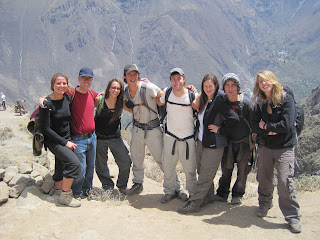
The group dynamic started to become apparent around this time. We were eight people, plus a guide. Six were Israeli, one French, and me. The Israelis were an interesting bunch: three guys, three girls, all in their early twenties. On one hand they were mature and sympatico, all had been in the Israeli Army (compulsory service), some as officers, some on combat or at least combat-ready roles. They were full of the proverbial piss and vinegar, spending 6 or 7 months away from home in South America, trekking, rafting, horseback-riding, and the like. On the other hand, they still exhibited the self-centeredness and petulance of youth. For most of the trip the spoke exclusively in Hebrew, though they all could speak English, and the French woman and I were insufficiently talkative to induce them to switch that often. I don't really know what to make of this or how I would have behaved in their position, but I think some extra effort could have been made. That was the most annoying, and then there was the kvetching about such things as the size of the meals and other aspects of the tour, the tardiness at getting up in the morning (delaying the group), etc. Here is the group in happier times (from left: Melinda (French), me, Shy, Eran, Grady, Hagar, Dor, Ayelet--some spellings approximate).

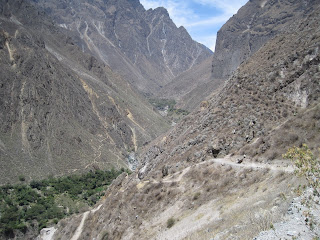
But on to the trek. The first part was a downhill hike from a height of about 3300m down to around 2200m. From a distance the hillside trail looks precipitous, and it is, but only if you actually fall off. In reality, it was quite safe: most of the time it was wide enough that two people could walk side by side, and the exposed side was banked up with rocks. One special precaution: if you meet burros or mules on the trail, stand on the inside and let them pass--they can knock you off, not so much because they are unpredictable or malicious, but because they carry wide loads. Besides, they are more competent than we are at navigating these paths.


You'd think this would have been the easiest part, and it started off that way, for me at least. As easy as falling downhill. Here are a couple of views of the downward trek:


Gradually, though, the path became rockier and I found that this caused my feet to rub against the sides of my shoes, threatening blisters. There was also more hard impact with the rocks, unsettling my lower legs. By the time we got to the end of the first stage of the hike, the town of San Juan de Chuccho, I was lagging behind the group by 15-20 minutes and really wondering if my feet would last the trip. Not tired or winded, just the complaints above. This stage took about 3.5 hours. When I told the guide about the impending blisters, he suggested that the next day I could go up by mule--however this was too much for my pride to countenance.

However, after a lunch stop of an hour or so we started up again, but this time the path was gentler and less rocky--some flat parts and some uphill, then another downhill climb but on a similarly friendly path.


This stage was perhaps 2.5 hours. By this time I was slightly tired but my feet were feeling considerably better. At the end we arrived at our lodging for the night, a set of cabanas referred to colloquially as "The Oasis". No town in the vicinity. The lodge was rough but decent, and there was even a swimming pool. This time I overcame my self-consciousness and took a dunk. Though it is a good thing that I don't have to swim for my country or my life.

Afterward we sat on the grass and drank Israeli coffee, and did manage to get the kids to open outward for a bit. It was also the first time I was offered drugs in South America. I declined: I don't do them at home, and even though we were in the middle of nowhere with no narcotics police around I'd rather stick to the principle of just saying no). We had supper around 7 and afterward gradually turned in since we had a 4.30 awakening.

Saturday, October 30, 2010

A nice place to stay for 400 years

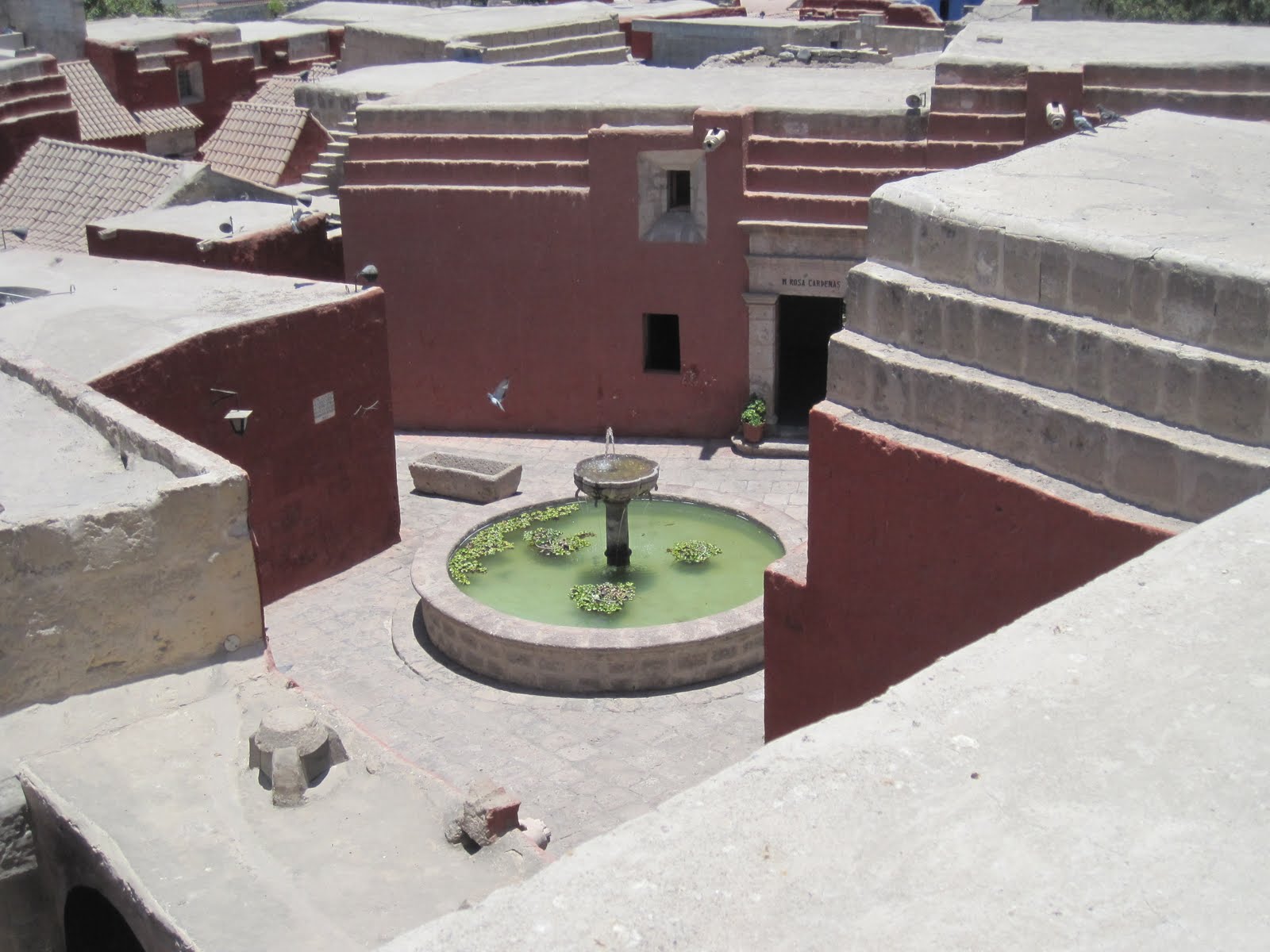
No, I'm not planning to spend the rest of my life and five future lives in Arequipa. Yesterday I visited what is probably Arequipa's most impressive site, the Convent of Santa Catalina, which was founded in 1579 and still exists. The current nuns (who are few in number) live in the new convent; the old one was opened to the public in 1970.

It's a pretty extensive place--about 2 hectares according to my guidebook, and I can believe it. It occupies the equivalent of several city blocks. The nuns who inhabited it lived more or less in seclusion from the outside world. Well, not complete seclusion: they weren't allowed out (ever, as far as I know) allowed visits every now and then, but only through a screen.


The girls who entered the convent were the useless daughters of rich families, who had to pay 100 silver pieces a year (I don't know what that is in today's dollars) to keep them there, and if I understood correctly, 1000 when they took their final vows. The families also had to build the rooms in which the nuns were lodged. Girls entered at age 12; the alternative was getting married at a similar age.

Life in the convent wasn't all bad, though. The beds may have been hard, but the rooms were large--probably three or four times as big as my hotel room in Arequipa.


(This is not my hotel room.)

And each nun had two or three servants (all women), who actually made up the majority of the inhabitants. And they could eat off their best china:


All good things must end, however, and after the First Vatican Council in 1870, the Pope put and end to all this "luxury", and booted out the servants and made the nuns live in dorms.

I haven't yet given you an idea of howtruly impressive this complex is. Have a look:


It costs 35 soles (about $12) to get in (down from 100 pieces of silver I guess) and if you want a guided tour (many languages available) there is an "optional tip" of 20 soles. I found the tour interesting, and have cribbed most of the information in this post from what I remember (I didn't make the same mistake as my guide and call the Vatican Council "the reformation" though :) I wandered around for a while on my own after the tour and took more photos. I've said many times that if I had lived in the Middle Ages I would have entered a monastery, and this place did nothing to change my mind on that. But as for my own middle ages, I think I'll stick with life on the outside.

Friday, October 29, 2010

Some things left behind in the desert

Some leftover business from Chile. When I was in San Pedro I took a couple of trips into the Atacama desert that I don't feel like narrating: I'll just let the pictures tell the story. I've uploaded them to flickr in a set called "Atacama desert" (how bloody prosaic). Here's a sample:


Click the link above for more.

Thursday, October 28, 2010

Another way of getting to Peru

This morning the manager of my hotel in Arica phoned the Customs (Aduana) office again to confirm that they were not on strike. No problem. So I get to the bus station, go to the ticket counter of the company with buses to Arequipa and ask to buy a ticket. No. The Aduana is on strike. This time I argued: "No, we just talked to them. They're not on strike". "Well, they didn't advise us that they weren't on strike." Duh. Somehow it sounded more like the bus company didn't want to know about the strike being over. So I asked if there was another company that went to Arequipa. No. Then I finally got some useful information: if I went to the international station next door, I could get a colectivo (shared taxi) to Tacna, Peru, just over the border, and then get a bus to Arequipa from there. Lest I sound like a total dunce, I had scoped out the international terminal a couple of days before, saw lots of companies going to Tacna, but none to Arequipa, so I assumed the company I had located in the national terminal was the one to go with (and the day I went there, they did claim to be selling tickets to Arequipa!)

I walked over to the international terminal (which is basically a rough parking lot with a bunch of small offices along one side, and a bit of a free-for-all generally) and was approached by a tout asking "Tacna?" Si, Tacna. He led me to a car, where the driver asked for my passport. I didn't feel entirely right about handing over my passport to someone I just met, but sometimes you need to go with the flow. I watched the guy and he didn't sell my passport to secret agents, just kept on shilling for passengers. Eventually he rounded up five people (for a fairly compact vehicle) and then asked us all for 200 pesos. I wasn't sure what that was for, but everyone else was giving him the money. It turned out to be a fee for a Peruvian immigration form.

Off we go in the direction of Peru. We stop at Chilean immigration, and I get my passport stamped for exit. Then a little further to Peruvian customs and immigration, where I get a Peruvian entry stamp and a 90-day visa. Well, I won't be here that long. I put my luggage through the scanner and was good to go. It takes about half an hour to get to Tacna. I thought I was being let off at the national bus terminal but actually it was the international terminal. Fortunately, as in Arica, they're next door to each other.

I must have looked either lost or just foreign, since a pleasant woman who worked at the information desk came up to me and asked if I needed help. When I explained that I needed a bus to Arequipa she directed me to an agent. This agent asked if I wanted a bus now or later, so I said now. She printed out a ticket for me that said 9.30am, which was confusing, since it was by now just after 11. My mistake. I had forgotten for the moment that Peru is in an earlier time zone, and I didn't know that it doesn't use Daylight Time, so actually it's two hours behind Chile, meaning that it suddenly was now only 9-something. Great--I temporarily get two hours of my life back, making up for a couple of boring meetings or some such.

Eventually I got on my bus to Arequipa, which took us through what must be the bleakest landscape I've ever travelled: more desert-like than anything I'd seen in Chile. This was unending grey plains and hills as far as the eye could see, for hours on end.


As we got closer to Arequipa, the road became more winding and mountainous, which at least added some thrills. It was still hard to believe that a city of 1m people was suddenly going to appear, but it did, and here I am. I haven't seen that much yet. The streets were busy tonight since there's some kind of religious procession going on, with a large effigy being carried through the streets, and men in purple robes.

Wednesday, October 27, 2010

Canadian bank does something right

When I take out money from ATMs in Chile I get dinged with a CH$2500 ($5) transaction fee. Ouch! That's 5% if you take out $100. The less I take out, the higher that percentage becomes, the more I take out, the more money I have waiting for no good to come of it (I'm not seriously concerned about theft, but on principle when travelling one likes to have as little cash lying around as is practical). A German woman told me that she takes out money from Scotiabank in Santiago and doesn't pay any fees, so today when I needed money and noticed there was a branch here in Arica, I thought I'd test that out. Winner! Either they didn't charge a fee or else did and lied about it :-)