Wednesday, October 27, 2010

Still in Chile

I got to the bus station in Arica this morning only to be told by the bus company (apparently the only one that sells tickets to Arequipa) that because the Aduana (Customs) was on strike, no buses could be processed through to Peru. I didn't think to ask which country's Customs was not working, but high-tailed it back to the hotel I had just left, hoping my room was still available. Turned out it was, hadn't even been touched.

I Googled to find out what was going on and somewhat to my surprise that there was a 24 hour strike yesterday, with the threat of further action if the workers' were not "listened to". Huh. I called the Aduana directly and was told that yes, there was strike yesterday, none today. Seems that the bus ticket agent was full of it. Perhaps I shouldn't have taken her word for it and asked around, but I assumed a bus company would know. Oh well. I guess it wasn't my day to go to Peru. I cancelled my hotel reservation in Arequipa and made a new one at a cheaper (but still ok) place. The manager of my hotel called the Aduana this afternoon and was given the all clear for tomorrow.

Anyway, if I had gone to Peru I would have missed two excellent exhibit that I saw this afternoon instead at the archeology museum in Azapa, just outside Arica. One was on the history of the native peoples who lived in this area. I like these four-pointed hats--the design indicates your social class.


The other was about the Chinchorro mummies, the oldest known examples of mummification in the world, dating back to 7000 BC. The process doesn't involve embalming--basically all the soft bits are scooped out, the limbs reinforced, and the skin refilled with mud and other substances. I expect that the natural dryness of the area helps.


I also would not have found out that the hotel has a pet turtle, Natasha, who is 38 years old. The owner once tried to match her up with a male, but the two didn't get along, and the dude was soup.


While I'm at it, I can recommend my hotel, Hostal Jardin del Sol, to anyone who comes to Arica. It's probably the best value-for-money hotel that I've stayed at in Latin America. For CH$10000 a night ($20) you get a clean, well-maintained, private room with bathroom. Breakfast (somewhat on the continental side) is included. There's cable TV with English and Spanish stations in each room (I didn't come to Chile to watch TV, but it's there if you want it). The staff are friendly and helpful. There's a kitchen and computer room. My only complaint is that the wifi seems to wink out with some frequency.

Tuesday, October 26, 2010

Little things that are different

In Chile, a tortilla is not a round flat thingy made of corn or wheat, it's an omelette.

Beans are not frijoles, they're porotos.

A frutilla is not a little fruit, it's a strawberry (elsewhere known as a fresa).

Bread with your meal is served with salsa, not butter.

This is goodbye to Chile for a while--tomorrow I head for Arequipa, Peru.

Sunday, October 24, 2010

Catarpe is a state of mind

Constant readers of this space will remember that a couple of days ago I tried to walk to a village outside of San Pedro but got waylaid from the true path by the promise of a tunnel and some rocks (had there been magic beans as well, I probably never would have come back).

After a day of rest and blogging, I made the attempt again today. After my previous experience I stocked up on plenty of water and four--count 'em--chocolate bars. Not the best nutrition but light and lots of calories per 100 grams. This time I decided to increase my energy efficiency by renting a bike. Mountain bike rental outlets are ubiquitous here. I had noticed a couple of places the day before that seemed to have decent bikes, but at 10am this morning neither were open (perhaps the owners were at church: in a place this size, there are at least three options--Catholic, Pentecostal, and Jehovah's Witness). Anyway, the first open place I came across was a combined internet cafe and bike rental. Their prices were lower and the bikes not as shiny but there was nothing decidedly dodgy about the joint. I didn't know whether to be comforted or disturbed when in addition to the bike I was issued a spare inner tube, a patching kit, pump, and a flashlight. Either lots of things go wrong or they really care about their clients (or their bikes). A welcome addition was a helmet. This was unexpected as I hadn't seen anyone in San Pedro riding a bike and wearing a helmet.

I told the guy I was going to Catarpe and he drew me a map, the gist of which was that I continue on the same road I took the other day, until I come to a stream, and which point I cross and turn left for Catarpe and right for something else called Quebrada del Diablo. diablo I know, quebrada I wasn't sure of but I thought it meant a brook or river. As for the stream in question, special instructions: don't ride across, take off your shoes and carry the bike. Not sure if this was for my comfort or the health of the bike. He also said it was 20m wide.

I should add that I can't remember the last time I rode a real bike, instead of the stationary ones at the Dunfield Club. Not that I had forgotten how or anything.

So I duly ride out into the desert, for about 4km or so, reach the stream (which was less than 20m wide, at least at the narrow point where any sensible person would cross), ford it magnificently, and take the first left, despite the lack of a sign saying "Catarpe this way". I kept on going, wondering where Catarpe must be, because I had been led to believe that it was 4-5km away. Eventually I reached a second stream, or really, the path crossed the stream again. This time it was wider. Ok, shoes and socks off, roll up pants, sling shoes over neck, and walk across. Bike does not touch water. Nothing but air! Reverse previous steps.

Aside: there's a trick to crossing rocky streams. If your foot hits a rock, it hurts, and your spinal cord says "foot, move" (remember what you learned in science class about what happens when you touch a hot stove--your brain is the last to know). If this happens, you tilt, and if you're not careful, you end up in the stream and you and the bike get wet, as does the saddle bag containing your camera. So, you just have to creep along the bottom so that you don't strike anything in a way that hurts.

So, more road, no village. Eventually a third crossing of the stream. At that point a guy in a 4WD was crossing behind me, so I asked him if I were going to either Catarpe or Quebrada del Diablo. Negative on both, amigo. Plus, the route from about a km on was not doable by bike. The truth of that last statement was that it was about 100m on. So I turned around and ended up back at the first stream, where a bunch of people were picnicking. I asked them and I was told to cross back over the stream and I would find Catarpe. I was dubious (since I hadn't seen Catarpe on the way out), but I did it. After a few more minutes I was more dubious. I saw some guys up to something or other just off the side of the road, so I asked one of them.

Here is where I attained sudden enlightenment. Catarpe is not a village. There is no village. Catarpe is just an area, perhaps with some legal status, but definitely not a place where people live. In defense of my stupidity, I specifically asked the guy working at the Pukara de Quitor if there were a pueblito in that direction, and he told me there was. Perhaps his definition of pueblito encompassed the encampment a few hundred metres off the road surrounded by old vehicles. Sigh. But the good news was that I had been to Catarpe, and the picnickers were full of it, and I had still gotten a nice ride out of it. Lesson: do not believe a man just because he speaks eloquently in Latin. Or any derivative thereof.

This news also meant that if I went back and turned right, I would get to Quebrada del Diablo, whatever that was (the guy who rented me the bike said it was "interesting"). So, I rode back and crossed the first stream for the third time. Exit, stage right. Well, a quebrada, as I later learned, can be a gorge, and that's what I got. Not one with water, but high rock walls and a sandy, winding path.
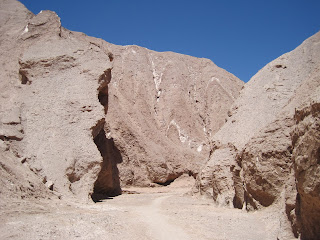
Sometimes underneath solid rock.
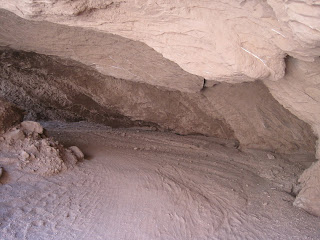

Sometimes with a ledge that means you have to stop and hoist the bike up first. I was getting a little ticked with this bike that I had to carry so many times when it was supposed to be carrying me.
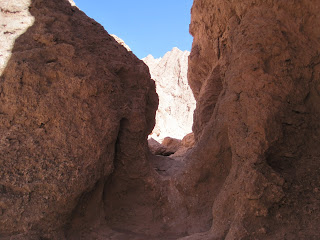

More long and winding road for 20 minutes or so. Then...The Hill. There was no way I was going to ride up that thing. In addition the path being a bit precipitous, my 49-year-old lungs and legs were not up to this job. So I walked the bike up, and it became obvious that them organs were not really up to that either. I was maybe 10m from the top and not feeling hopeful, so I left the bike behind and scaled the mount to see if what was on the other side was going to be any better. Five minutes walking the trail convinced me that just more lung-torture was on the way. But i can handle being bested by a clearly more powerful foe. I sat atop the hill for 20-30 minutes and contemplated various things, not the stuff Pei Mei contemplates, just my stuff.

At around 2.30 I decided to make my way back. Getting the bike back down the hill was non-trivial, since its momentum wanted to make me go faster than I thought proper on a hillside path. I basically rode the brake down. A pleasant surprise was that the way back was slightly inclined downward--so slightly that I hadn't even noticed it on the way in, but enough that I could coast a lot of the way back without at the same time worrying about embedding my head in rock.

Back to stream, cross again. Here is when I have to get philosophical on you. The Sophists will tell you that you can't cross the same river twice. Don't you believe it. Certain adepts have managed four crossings, on the strength of two chocolate bars, even.

I got back to San Pedro at 3.45. I still had 45 minutes left on the bike rental but my butt was sore and I had no place else I really wanted to go. I calculate that at this point my body was no more than 1% bicycle. All things considered, a good day.

(The bike cost me 4000 pesos ($8) for a half day (6 hours). A full day would have been 7000 pesos. The places I saw yesterday were charging 6000 and 8000 per half day. You pays yer money and you takes yer chance.)

Saturday, October 23, 2010

Geezers gazing at geysers

One of the most popular tours from San Pedro is the El Tatio geysers tour. This despite the fact that you have to be outside your hotel by 4am, dressed for below-zero weather (it's nippy at 4am in San Pedro, and nippier in the middle of the desert. I had on a shirt, fleece jacket, hoodie, and gore-tex jacket. Foolishly, I forgot to wear the gloves that I had packed just for occasions like this.

I had booked my tour with Cosmo Andino Expeditions, for which I had received recommendations from a couple of sources. I'll add my own to that, even though the first thing they did was a screw-up--the driver slept in so we spent an extra half-hour in the cold. The tour cost 25,000 pesos ($50) and lasts from your 4am pick-up until you are dropped off back in San Pedro around noon. I was joined on the tour by a couple from Hong Kong who were staying at the same hotel--probably the first HK travellers I've ever met in Latin America.

Anyway the van arrived and apologies were made. Our guide was a very affable and knowledgeable fellow named Oscar who spoke excellent English with a perfect British accent (not the Queen's English--think Coronation Street instead). It turns out there is a good reason for this: he was born in England after his parents moved there to escape the Pinochet dictatorship. He lived there into adulthood, came to Chile to travel for a while, met a Chilean girl, and stayed and became a tour guide.

The route to the geysers is not a smooth one. The road is unpaved and very rutted, not conducive to manufacturing a few lost Zs. Along the way my arse fell off and one kidney may be permanently misplaced. In case you're wondering why all this has to be done at or before daybreak, no, they don't turn off the geysers at 8am or anything, they just look better when the air is colder.

So we--and perhaps a dozen other tour groups--get to Geyser Central, pay our admission (I think it was 5000 pesos--$10) and the first order of business is breakfast, supplied by Cosmo Andino and included in the price. My fears of not getting a cup of coffee ended.

Then we went to the geyser field. If I had read the Wikipedia article on El Tatio that I linked above, I perhaps wouldn't have felt the teensiest bit let down that the geysers were, it has to be said, a bit puny. I guess I was expecting Old Faithful. But, as the old line about boarding house food goes, at least there's lots of it. I shouldn't be too negative here--they are a significant natural phenomenon, just not quite what I expected.

So basically there are a bunch of holes in the ground, up from which comes bubbling boiling water, creating a vapour cloud. The field is about 4200m above sea level, so water boils at somewhat under 100C there. Some clouds are higher than others, as you'll see from the pictures. Some geysers "erupt" on a regular schedule, which of course the guides have knowledge of so that they can wow us when their predictions come true.


After the geysers a hot spring to swim, or "bathe" really, for those who had brought bathing suits and were comfortable in their semi-nakedness. The rest of us took pictures, not so much of the bathers, but of flora, fauna, and geological phenomena in the area. I did take a picture of some bathers, but the Spanish woman I had been hanging around with seems to have deleted it from my camera, on the grounds that she was in it. Oh well. One body's much like another, but it's not everywhere you can find green rocks. Some plant coats them, creating the effect. Our guide said that it was a very good source of fuel.


This one was probably put there by aliens:


The fauna consisted of these bunny-like creatures (but really a kind of rodent) called vizcachas. Somehow they missed having their tails bobbed.


The water bubbling dpown the hill into the swimming hole produced some neat fire-and-brimstone effects. I think you can see the devil's face in this picture.


Our next stop was to see more fauna, with clothes on (us, not the fauna). There were some birds (yawn) but most important, vicuñas. These animals were previously hunted for fur (they only produce about 250g of fur, but it's supposed to be almost as soft as silk) and longer ago for meat. Now they're a protected species.


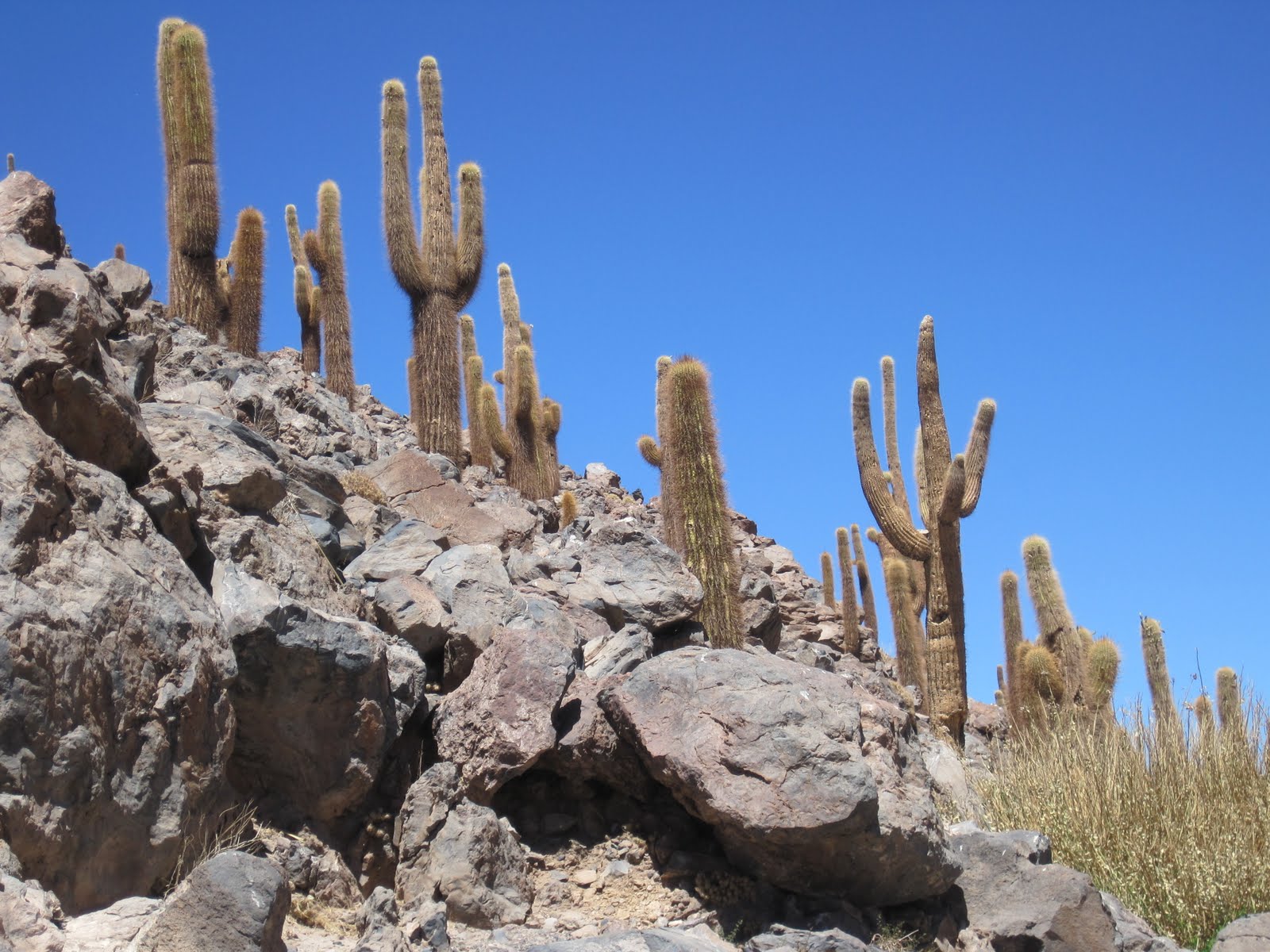
Our last stop, and for me the best part of the tour, was to see giant (though, it must be said, not gigantic) cacti. So I was a bit put out when my camera battery died just after we got there. This is also a protected species, since it was being used for its wood. The protection afforded is not as strong as it could be, since it's illegal to cut down cacti, but legal to use cacti that have fallen down. And who's to say that cactus wood that someone brings home wasn't from a fallen soldier?

Friday, October 22, 2010

Today's news today, yesterday's news tomorrow

After two days of taking guided tours here in San Pedro de Atacama, today I set out on my own, with no-one to pay for my passage. I'm not a big fan of tours, but there are places that there is no local transport to, so tours are the way to go. They have the added advantage that you meet other travellers, such as the lovely Colombian woman that I had a drink with after yesterday's tour.

Let's back up a bit: San Pedro is kind of an oasis (or maybe outpost) in the Atacama desert (the world's driest) that seems to exist mainly for the purpose of selling tourist services--hostels, meals, tours, handcrafts--to people like me who want to see geysers in the desert at 6 a.m. or pink flamingos on the salt flats. But you'll hear about all that in another posting.

Today I just walked in the desert--but since it's all desert around here, you can't help it. First to Pukara de Quitor, about 3km from San Pedro, which is a kind of fortress that the Atacaman people used to defend against their enemies around the middle of the last millennium, something that was put to an end when the Spanish arrived and chopped off a few hundred heads.

The ruins are terraced up the side of a hill. You can walk up to the top in about 10 minutes. It looks like a place whose inhabitants must have been impressed with at the time, until the Europeans came by with their guns, germs, and steel. My peace was disturbed somewhat by a large school group that I knew were on their way up after me, so I didn't tarry long at the top.


Back at the bottom again, I noticed there was a path up to a mirador (look-out point). I can never resist a mirador. This trek wound its way up the side of a hill and took a bit longer to complete, maybe 20-25 minutes, but I wasn't really trying to motor. There were a couple of stopping points along the way, one with a monument in which was inscribed a poem by Gabriela Mistral, another that looked like it might have been intended to be a fountain. Perhaps a fountain in the desert wasn't going to work out, though I assume there are ways of conserving the water. At the very top there were four large yellow concrete crosses positioned in a square, with the line "My God, My God, why have you forsaken me?" in Spanish, Portuguese, and two other languages that I either forget or didn't recognize. Behind the crosses there was a shaded place where you can sit, so I did, perhaps to contemplate forsakenness. I descended at around noon. Here is what San Pedro looks like from the top:


I knew there was at least one village beyond the Pukara, about 4km away, so I walked in that direction. Here is some interesting grass from along the road:

About 1km along I came to a fork in the road promising, to the left, a tunnel, some rocks, and another thing I didn't understand. How could I resist? I took the road less taken. After a half hour or so I started wondering if there was anything up there. A passing cyclist on the way down confirmed the existence of the tunnel, so I plowed on, and duly arrived. Unlike the other tunnel I walked through on this trip, I could see the other end from the opening. An engraving in the keystone indicated that it had been built in 1930, presumably to get from one side of the hill to the other. It took maybe four minutes to traverse. About halfway through there was a large boulder almost blocking the way. My guess is that it had simply fallen there, but I didn't check the roof for a gap of similar size. The tunnel wasn't bright like in this picture: my camera must be doing some kind of "correction".


On the other end of the tunnel there were more hills and a vague kind of trail but no signs or you-are-heres or Usted-esta-aqui even, just a vague kind of trail formed by bike and tire tracks (and the odd bit of horse dung) that led...somewhere. Up for a small amount of adventure and uncertainty, I kept going, and going, and going. I took a lot of pictures, but I was getting more and more skeptical that the path actually led anywhere (ideally, to the village that I originally set out for).


The lack of wisdom in setting out with only a relatively small amount of water and a chocolate bar also became apparent. I was either stunned or else expected to arrive at the town, where more could be procured. The sun was hot but not scorching, but still, the body has needs.

By 3.45 I gave up on the idea of reaching anywhere except sweet bugger-all by continuing on this route. I also wanted to get back to San Pedro before it became either dark or cold. So by this time I was hungry, thirsty, and my hips ached. But, as they say, worse things happen at sea. If whole armies (to mix military metaphors) marched on empty stomachs, I could manage it too. The way back was a bit of a pain but I made it back to San Pedro three hours later. If I had paid closer attention to the map that had been posted just beyond the Pukara, I would have realized that I wasn't going to get to any damn town (in fact, according to the map, if I continued the trail would have looped around at the end.

When I got back to San Pedro my first stop was to get water. I would have gone to a restaurant and murdered something but I and some others on the tour I took yesterday had been invited to meet for supper by an Australian girl who was on the trip. When she didn't turn up I went to her hostel and was told she had left for Bolivia. Life on the trail I guess.

Tuesday, October 19, 2010

A peripatetic in search of a stopping point

Despite my current peripatetic lifestyle, what I really want to do now isn't travelling. I want to find a place in Latin America where I can settle down for about a year and become part of the scenery and have the scenery become part of me; to become a creature of habit again, but with new habits in a new place. After quitting my job I might have done that in Toronto were it not for the fact that it's expensive to live there without an income. But I think I can afford to live anywhere I want in Latin America--not in all the poshest neighbourhoods, but somewhere in any town or city. I should add that a cheaper place to live is not the only reason to move to Latin America: I've been studying Spanish in a desultory way for years and would like to achieve some semblance of fluency; and living (not just being a tourist) in another country is something I've wanted to do for some time--among other things, it would be good for me, and not in the same way that a smack upside the head would be good for me.

One thing I'm hoping to do on this trip is find a place to send out shoots, if not actually put down roots. I'm kind of demanding, though (see point one below). Hard to please. Always feel that something's missing. Maybe it's the organelle in my cranium that enables one to say, at least some of the time, "nothing's missing--this is just right" or "something is missing, but it doesn't matter".

Here are some of the things I'd like to find, in no particular order. I don't expect to find all of them, and some may be contradictory.
  • Just walking down the street should be like going to an art gallery (such places do exist, and in Latin America too, so I'm not completely out to lunch on this one). This could be satisfied by either manufactured or natural beauty (though I was mostly thinking of the former).
  • It should be possible to live on about $1000 Canadian per month, not counting trips back to Canada.
  • It must be a Spanish-speaking location.
  • The place shouldn't be overrun by people like me (expats) though some would be ok.
  • I need to be able to find a place (such as a café) where I can go and read and relax for a few hours on the strength of buying a coffee or two.
  • There should be convenient access to nature: places to hike or at least a good park. Convenient could mean taking a bus for an hour or so.
  • I shouldn't have to be concerned about my physical safety on a regular basis. It would be even better if this were largely true of the country as a whole.
  • It should be warm-to-hot (including night-time) for almost all of the year.
  • Some kind of "cultural life" should be possible, as evidenced perhaps by the presence of a university, cinemas, theatres, and the like.
  • I'm thinking around 100,000 as a minimum population
  • If the city/country has a significant indigenous population, that would be a plus
Is this kind of laundry list the right or wrong way to go about finding a new home? Is my list totally off base? Just today I talked to three people (all from Germany) who had spent a couple of months in La Serena, which I just left and felt there was little to do in (despite it being a pleasant city). They all liked it because they had made friends there and had an active social life. Obviously that makes a difference--though some people find it easier to make human connections than others...hence the laundry list. Ultimately my decision will be made on the basis of some kind of intuitive reaction to the place in question: the checklist is my best guess at what will inform my intuition.

Monday, October 18, 2010

Elqui Valley

La Serena is a nice enough place but there isn't a lot to do in the city itself except go to the beach. Most people I've met here come here to do some combination of the following three tours: Humboldt penguins, Elqui Valley, and Observatory (this part of Chile is prime territory for astronomy). Well, I went with the first two (Bill, if you're reading this, I know, shame on me).

The Elqui Valley is an agricultural area east if La Serena. I took the tour with the same company that took me to see the penguins, thus getting a 2000 peso discount. My tour group consisted of me and eight others, six from Chile and two from Peru. So most of the explanations again were in Spanish, but our guide, Marcelino, was a Chilean who had lived in Alberta for 13 years and worked as a Greyhound bus driver, and hence spoke excellent English, so I got recaps. This time the van and guide belonged to the tour company itself instead of being subcontracted, and the problems of the previous tour (including the lack of seat belts) weren't an issue.

All along the way we got commentary on the crops growing along the road (90% of which were grapes) and some interesting tidbits of information such as how to tell whether vines are growing table grapes or pisco grapes (the latter are higher since they need sun, not humidity).


(These look like table grapes to me.)

Another disheartening fact is that almost all of the agricultural land in the valley is owned by multinationals such as United Fruit Company and Del Monte.

There were a number of stops along the way, including the towns of Vicuña and Pisco Elqui. We also got a free 15 minute stop at the Gabriela Mistral (Chilean Nobel Literature Prize Winner) museum. The most notable display there was a tree in the back yard that introduced me to a fruit I had never heard of before, the nispero (loquat in English). It's about the size of a large grape and has 3-4 large seeds that comprise about half of its volume.


In other fruity news, at one point we stopped in front of someone's house to admire a fruit tree growing there and suddenly a woman (a confederate of the guide?) came up to us and gave us a box of these:


They're called lúcumas. This article in Wikipedia has a picture of a somewhat bigger fruit (these are about the size of eggs) but otherwise describes accurately the taste and appearance. As suggested, I think it would make a good flavouring for ice cream. Perhaps I'll find it in Peru.

For lunch we were taken to a restaurant that cooks its food using the sun's energy--not solar cells, but ovens such as shown below. Apparently they can cook everything except French fries this way.


Here's another one showing how to boil water using the sun's rays.


The final stop on our tour was a pisco distillery. Here's our guide demonstrating one of the machines (used to separate the grapes from the stems and other gunk) that is no longer in use: